Stuck in the Pipes: Why a Global Flushability Standard Remains Out of Reach
Stuck in the Pipes: Why a Global Flushability Standard Remains Out of Reach
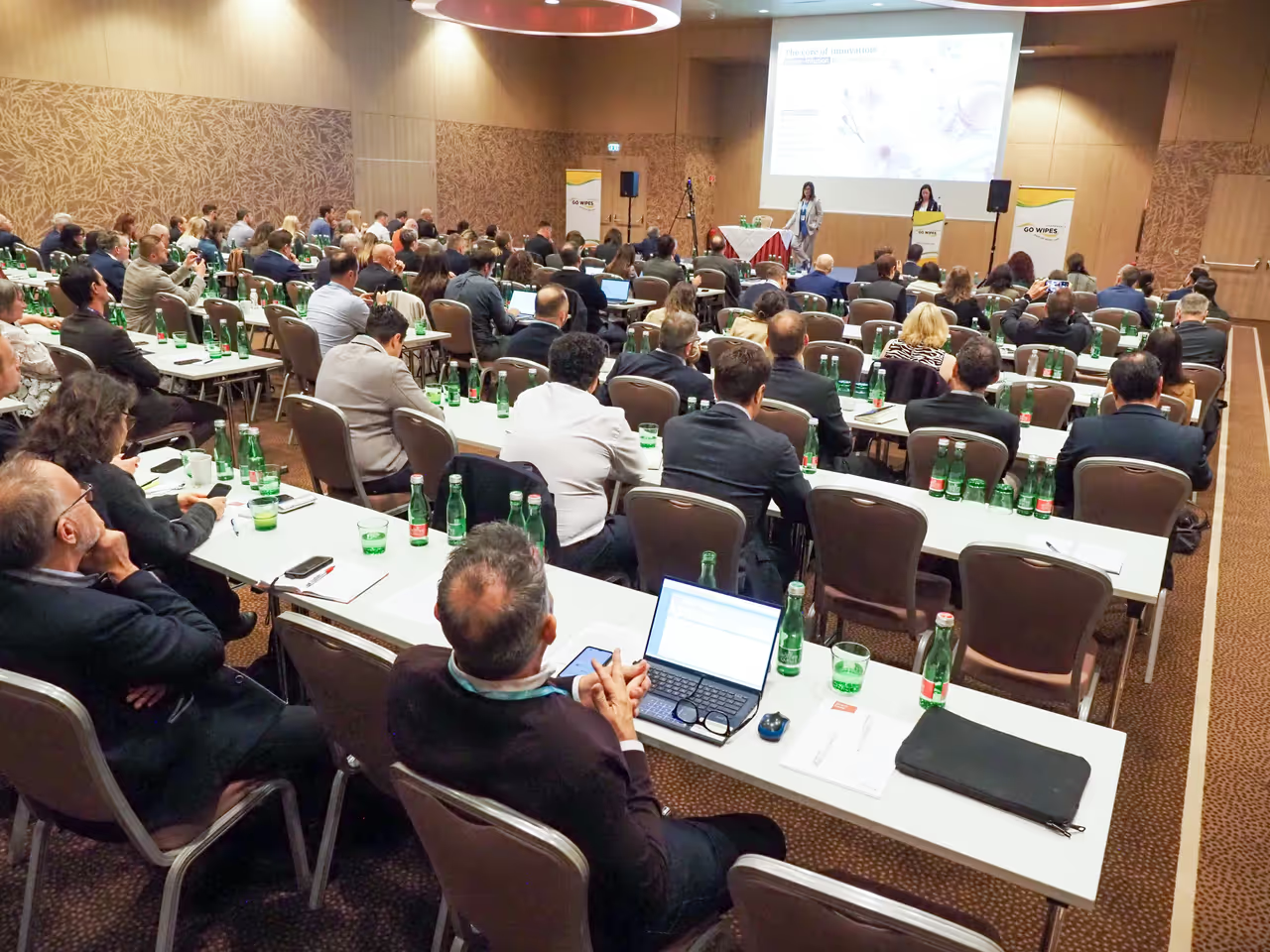
Reflections from My Presentation at Go Wipes 2025, Vienna
The debate over “flushable” products has been running for more than two decades, yet global alignment on what truly belongs down the toilet remains as elusive as ever. At Go Wipes 2025 in Vienna, I explored why progress has stalled, what the industry needs to understand about the international standards process, and how we can move forward together.
Although I participate in standards work, the views below—and those presented in Vienna—are entirely my own and do not reflect the views of the UK delegation to ISO TC224WG10
A Journey Through 30 Years of Flushability
The story of wipe disposal standards is long, technical, and often contentious. From early academic studies in the 1990s, through successive EDANA/INDA flushability guidelines, to ISO’s repeated attempts to create a unified technical specification, one thing has become clear: the world cannot agree on what “flushable” should mean.
This lack of consensus stems from deep philosophical and practical divides between manufacturers and wastewater operators. Many European utilities maintain the position that only pee, poo, and paper should be flushed—full stop. Meanwhile, industry continues to innovate and develop products intended to pass rigorous infrastructure-based performance tests.
The result? Conflicting standards, regional regulations, and consumer confusion.
Inside the ISO Process: Why Agreement Is So Hard
ISO Technical Committee 224 Working Group 10 (WG10)—the group tasked with developing international guidance on flushability—has faced significant structural and political challenges. ISO’s rules require consensus, defined not as unanimity but as the absence of sustained opposition.
Unfortunately, sustained opposition has been abundant.
Attempts to produce a Technical Specification between 2014 and 2017 collapsed. The result was a non-binding Technical Report in 2019 describing wastewater system conditions but offering no pass/fail criteria.
The current effort, the Draft Technical Specification ISO/DTS 18671:2025, aims to harmonise test methodologies and labelling requirements for wet wipes and moist toilet tissue. But progress remains slow, and in October 2024 the Draft International Standard vote failed, preventing advancement of stronger language or a unified positive flushable label.
A key reason for this failure is the simple, powerful position held by many European wastewater associations:
“If it’s not one of the three Ps, it shouldn’t go down the toilet.”
The Proposed ISO Technical Specification: Helpful, but Limited
Despite recent setbacks, the draft ISO/DTS still represents a useful step forward.
It includes:
- A suite of established test methodologies
- Definitions for wet wipes and moist toilet tissue
- A proposed international Do Not Flush (DNF) symbol
- Guidance on visibility, placement, and packaging size
- Recognition of the two dominant global testing families: GD4 and UK WIS
However, because WG10 is not permitted to set normative thresholds, the resulting specification cannot enforce a universal definition of “flushable”. Instead, it offers a framework—one that many regions may adapt differently.
I believe that the absence of a unified global positive label is a missed opportunity, and something I encouraged industry to reflect upon.
Why the Wipes Industry Must Stay Engaged
One of the most important messages from my presentation was this:
Standards will continue to evolve—with or without industry at the table.
Only three national delegations currently include representatives from the nonwovens and wipes industry. Meanwhile, water-sector associations across Europe engage consistently and robustly.
If manufacturers disengage now, they risk losing any influence over future international or national standards.
Active participation is—not merely desirable—the best strategic choice.
Beyond ISO: Regulation, Environment, and Behaviour
Flushability is no longer just a technical debate. It intersects with:
- Environmental protection
- Wastewater infrastructure resilience
- Consumer behaviour change
- Legislation on plastic-containing wipes
- Costs and operational challenges for utilities
Recent developments, including the UK Independent Water Commission’s 2025 report, highlight the scale of the problem: wet wipes remain a leading potential cause of sewer blockages and contribute significantly to microplastic pollution and fatbergs.
Campaigns such as “Bin the Wipe” (Northumbria Water) demonstrate that behavioural interventions can have a measurable impact. But public messaging remains fragmented—and the proliferation of different regional / international DNF logos only adds to consumer confusion.
This is another area where closer cooperation between industry, utilities, regulators, and retailers would benefit everyone.
Where We Go Next
From Vienna, my key message to both wipes manufacturers and wastewater operators was straightforward:
We must work together—or we will continue to go in circles.
Whether you represent a brand, a utility, a regulator, or a technical organisation, now is the moment to:
- Engage actively in ISO TC224/WG10
- Understand and prepare for diverging national standards
- Consider early alignment with the draft ISO DNF label
- Collaborate on round-robin testing to compare methodologies
- Prioritise clear and consistent consumer messaging
- Support behaviour-change initiatives alongside regulatory compliance
Flushability remains a complex, politically sensitive, technically demanding issue—but progress is possible if all parties commit to a shared approach.
The Slide Deck from the presentation may be downloaded from here.